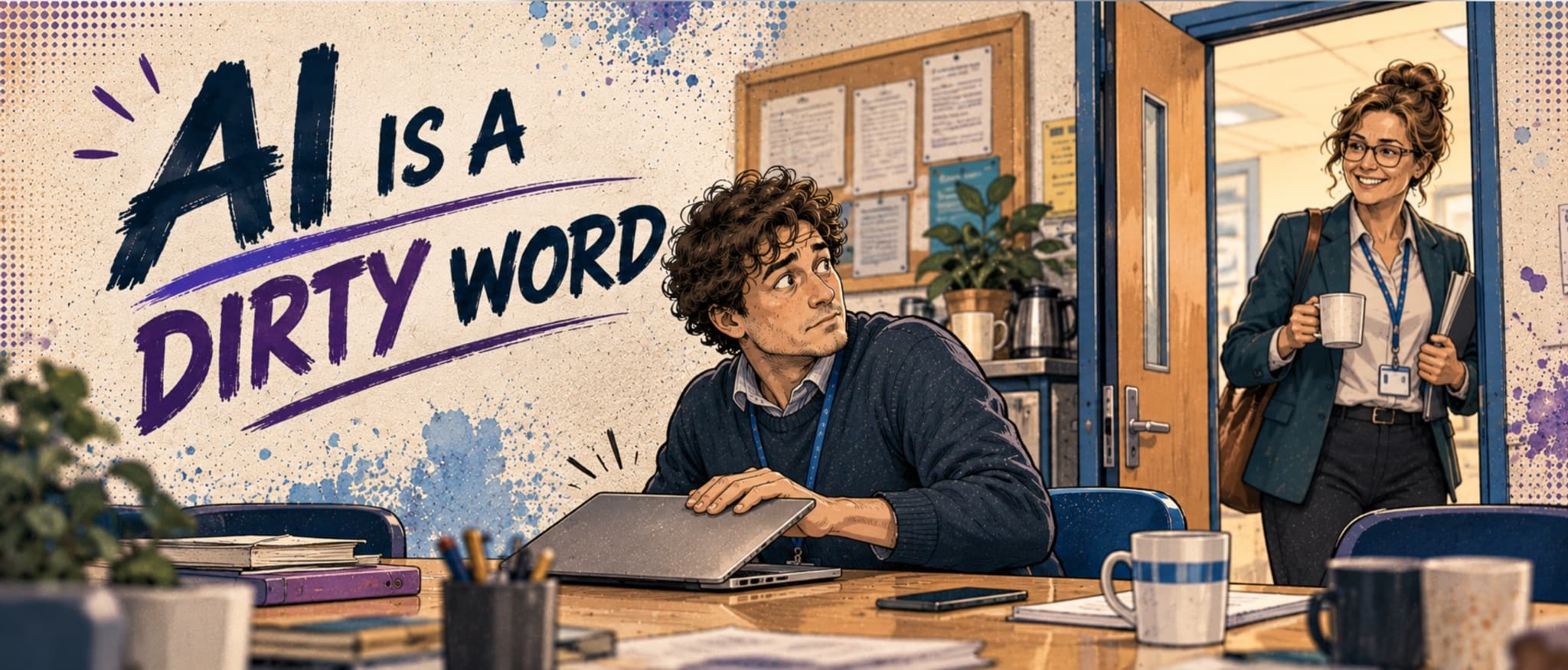
AI is a dirty word in teaching. That's a problem.
Ask a staffroom who is using AI. Anyone who puts a hand up will be nervous, wondering if there is a consequence or if they are in trouble. Nobody in that room wants to be seen as "cutting corners" or somehow cheating. This is across the board, speaking to teachers at multiple schools, a systemic culture.
Now ask the same people who used something to help build a worksheet on Sunday night. The temperature changes completely. That is just being organised.
Same technology. Same teacher. Entirely different social risk.
Some worrying numbers to digest
In 2023, Teacher Tapp asked teachers which tasks they could see themselves handing to AI. About 31% of secondary teachers said marking.
In September 2026 they asked who actually had. 7%.
That is 8,837 teachers, weighted to reflect the real school population, so it is not a rounding error. And it runs against everything else in the survey. Lesson planning overshot its prediction. So did parent communication. Primary teachers predicted 39% for planning and came in at 55%.
Marking is the only task that went backwards against its own forecast, by 24 points.
Think about how odd that is. Marking is the task teachers complain about most. It is the one that eats Sunday. It is the one that shows up in every workload survey, every time, as the reason people leave. The tools got exponentially better over those 3 years, not worse.
And it is the one thing teachers said they would hand over and then did not.
Why
Not because it stopped being tempting. Because of what it would mean to say out loud.
Using AI to make a worksheet reads as resourcefulness. Using AI anywhere near a child's work could read as not having read it, not putting in the hours, cutting corners or being workshy. Perhaps a shortcut taken with somebody's daughter's effort, or some type of character judgement.
So the calculation a teacher makes is not "is this a good tool". It is "what happens to me if someone finds out I used it".
In most industries AI signifies the organisation is modernising. In a staffroom it means you might have to justify yourself.
That is the stigma, and it is doing real damage, because it does not stop the behaviour. It just drives it somewhere nobody can see.
So where did it go?
7% is not zero. Those teachers exist. They are in your building.
They are not using a school procured system with a data agreement, because for most of them there isn't one. They are using whatever is free and open in a browser tab at 10pm, on a personal account, with student work pasted into it. No record of what went in. No retention policy. No deletion. Nothing a data protection officer has ever seen.
Not because anyone is reckless. Because they could not ask.
Teacher Tapp found 53% of teachers had no clear policy even for the much milder question of using AI to help write reports. If a teacher cannot get a straight answer on reports, they are certainly not going to open a conversation about scripts.
So the stigma produces the exact outcome everyone says they are afraid of. The use happens. The oversight does not.
Dear leadership
Here is the part that belongs to leadership rather than to teachers.
Many schools have not said yes to AI in assessment. Fine. That is a legitimate position and there are good arguments for and against it.
But most have not said no either. They have said nothing, which in practice means every member of staff is making the policy themselves, privately, on a Sunday, with no guidance and no way to ask. Because what if they are already in trouble?
No decision is a decision. It is just one nobody is accountable for and nobody can be trained on.
The DfE position is not ambiguous, incidentally. It actively encourages schools to use AI to reduce teacher workload, with safeguards and human oversight. The silence is not coming from the top.
Break the silence
Say the word out loud, in a briefing. Not a policy document. A head of department saying "some of you are using this, I would rather know than not know, and nobody is in trouble" changes what is sayable in that department within a week.
Decide the easy half. Most of the anxiety is about student work. Almost none of it is about a worksheet, a knowledge organiser or a first draft of a parent email. Separating those 2 cases publicly removes most of the fear and costs nothing.
Name the line on student data. Whatever your answer is. Never, or only in a system we have assessed, or not until we have looked at it in January. Any of those is better than no answer, because a teacher who has been told no will stop. A teacher who has been told nothing will improvise.
And ask. Anonymously, if that is what it takes. You will find out 2 things: that more people are using it than you thought, and that they are relieved you asked.
A school that knows what its staff are doing can govern it. A school that has made the subject unsayable has the same usage and none of the oversight, and will find out about it the hard way.
The teachers are not the problem here. They were willing 3 years ago. They are still willing. They are just waiting for permission that nobody has got round to giving them, and quietly getting on with it in the meantime.
I teach Citizenship and Business Studies, and I cofounded DeepMark, which marks assessments in collaboration with AI and keeps the teacher in charge of every mark. So I have a dog in this fight and you should weigh the above accordingly. I would rather schools decided this properly than decided it in our favour.
Sources
- Teacher Tapp, AI use among teachers, reported by EdTech Innovation Hub, October 2026 (8,837 teachers, weighted; 2023 comparison from 5,254 teachers).
- Teacher Tapp, The rise of AI enabled teachers, October 2025.
- Department for Education, Generative artificial intelligence (AI) in education, policy paper.
See it live
This is DeepMark marking a real script
Scroll through as it marks. Feedback and annotations appear as they land. Click anything, highlight, edit a mark to get a feel for how it works.