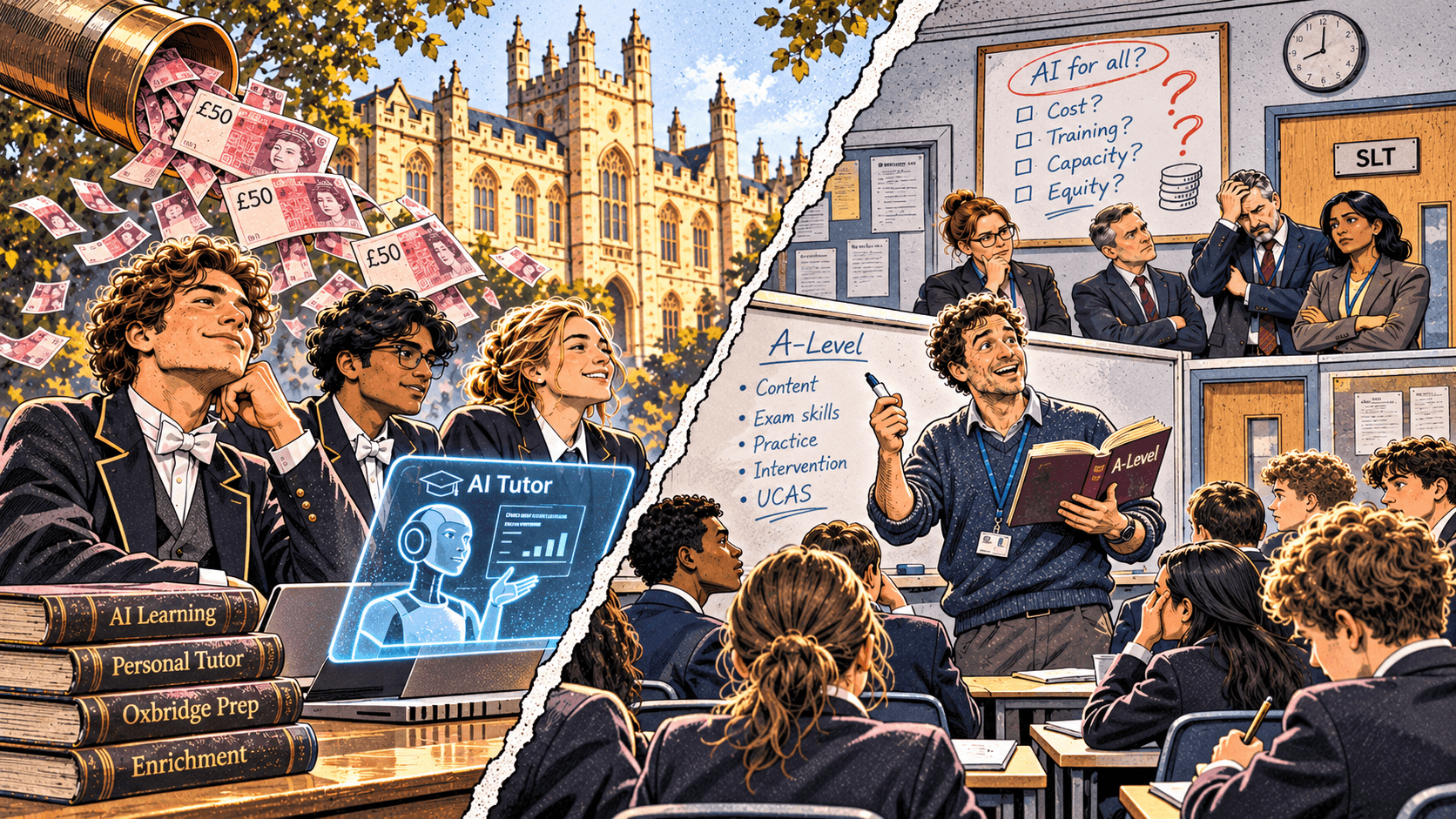
From Eton to Brighton, private schools have embraced AI
8 schools sent more pupils to Oxford and Cambridge than 2,900 other schools combined.
Equality of opportunity.
My brother's kids have a real shot at Oxbridge. Nobody in the family would call it a certainty, but it comes up over dinner in the same way you'd talk about where to go on holiday next summer. Where I teach, it doesn't come up over dinner. It does happen now and then, and when it does everyone is thrilled, but we're talking about a handful of kids.
I love my school, and I'm not saying any of this to have a go at it. I'm saying it because I've spent the last year watching the gap between those two dinner tables pick up something new to feed on, and it's the thing half my profession still doesn't like saying out loud. AI.
The leveller that just did not happen
For most of my career, the things money buys in education have been expensive and slow to arrive. Smaller classes, better facilities, pastoral staff who actually have time to notice when a child is 'out of sorts'. And private tutors, which are the big ones. A couple of hours a week with someone whose whole job is your child, at anything from £20 to £50 an hour depending on where you live and how worried you are.
Then something turned up that could do a reasonable impression of that tutor for a fraction of the price. I'm not going to pretend it's free, because it isn't, and the versions that look free are mostly paid for with whatever you type into them. In a school, that means children's work. But it is affordable in a way one to one tuition never has been, and 3 years ago I honestly thought it might start to close the gap between private and state schools. If every school could suddenly afford the tutor most families couldn't, surely that had to help.
It hasn't worked out like that.
What the private schools are doing
Eton has something called the CAITLIN Initiative, which is about making AI a normal part of teaching and learning there. They've built their own tool, CAITLibot, which writes AI powered learning activities so their teachers don't have to become prompt engineers on top of everything else, and they have a research centre whose job is to keep the school ahead of changes like this one. Brighton College is building an actual AI department, with a Director of AI in charge of an AI curriculum from 11 to 18 and policies covering academic integrity, data protection, safeguarding and ethics. Reigate Grammar has a Head of Artificial Intelligence and Innovation to write a whole school strategy. Wellington College has an AI Institute.
Good for them, honestly. They looked at the biggest shift any of us will see in our careers, decided it was coming whether they liked it or not, and put somebody senior in charge of it. Their teachers have had training, they know which tools they're allowed to use, and when they're not sure there's a named person down the corridor they can go and ask. That is what a school ought to do, and if I've got a problem it's with how few schools on my side of the fence have been in a position to do the same.
What the rest of us got
The Sutton Trust asked more than 10,000 teachers about this in 2025.
57% of state school teachers said nobody at their school was responsible for AI at all. Not even a deputy head who'd had it bolted onto an already incredibly difficult job description.
And it gets worse once you look inside the state sector. Formal training reached 26% of teachers in the most affluent state schools and 18% in the least affluent ones. So it's arriving in more or less the order you'd choose if you were actually trying to make things worse, with private schools first, the comfortable state schools after them, and the kids who'd benefit most somewhere at the back of the queue, if it reaches them at all.
The gap was there long before AI
None of this started with AI. AI is just the latest thing to roll downhill.
Those Oxbridge figures at the top come from the Sutton Trust as well, from 3 years of UCAS admissions data published in 2018. Nearly 2,900 schools and colleges against 8, and the 8 came out ahead. The same report found that pupils at independent schools were 7 times more likely to get an Oxbridge place than pupils at non selective state schools. When I've told people that, the most common reply has been "holy cow", which I think is about the right response.
To be fair to the universities, things have moved a long way. Around two thirds of Oxford and Cambridge places now go to state school students, and the admissions teams work hard at it. But by the time a 17 year old sits down to fill in UCAS, most of the race has been run already. Years of tutoring, the reading at home, the confidence, a teacher with enough time to push them. We put a lot of energy into arguing about the door, when most of the gap was built somewhere around year 7.
And just so nobody gets the wrong idea, I've got nothing against kids at private schools. They earned their grades, and their parents made a choice most of us would make if we had the money. Nobody wants them held back. I'd just like everyone else to be able to move forward as well.
Why state schools froze, and why I don't blame them
It would be easy to say state schools are just slow. I work in one, and I don't think that's fair.
A private school can decide on a Tuesday that it wants a Director of AI and have the advert up by Wednesday. It answers to its governors and its parents. A state school answers to a trust, possibly a local authority, Ofsted, a data protection officer who has read the headlines, and a budget that already can't stretch to the photocopier. When getting it wrong could mean a data breach involving children, waiting is the sensible call for a stretched leadership team, and that's mostly what has happened.
The trouble is that the marking doesn't wait. Teachers are still buried under it, and ChatGPT is one browser tab away. So the space where a policy should be gets filled anyway, by teachers at 10pm on personal accounts, pasting in children's essays because nobody has told them not to and nobody has given them anything better.
I met an English teacher recently whose school had "looked into" AI marking by trying Copilot. It was rubbish, which I could have told them, and as far as the school was concerned that was that.
This is the bit that really gets me. All that caution was supposed to protect children, and in plenty of schools it's done the reverse. The private school kid's work goes into a tool somebody chose carefully and checked. The state school kid's essay goes into whatever happened to be free that evening.
It doesn't have to stay like this
Most of the answers exist already. Somewhere, somebody has written the policy, run the training and made the mistakes so the rest of us don't have to. Epsom College has been working with the Bourne Education Trust, a state academy trust, on exactly this since 2023, with the stated aim of helping the least advantaged schools. Eton says its work is meant for its partner state schools as well as its own pupils.
That looks like the obvious model to me. I'm not asking for a new quango or a 5 year government strategy. The schools that went first could share what they've learned with the ones that couldn't, and state schools could be given permission, and a bit of money, to put one named person in charge. One person per school whose job is to answer "am I allowed to do this?" would change what happens at 10pm in an awful lot of kitchens.
Britain likes to think that where you start doesn't decide where you finish. For once the thing that could help isn't locked behind a fee, and it's still reaching children roughly in order of how much their parents earn. Nobody is buying this gap. We're just letting it happen, and it's new enough that we could still sort it out, if somebody decides it's their job.
Geoff Waugh teaches Business Studies and Citizenship in a state secondary school and is co founder of DeepMark. (We don't build AI tutors, before anyone asks.)
Sources
- Sutton Trust, Artificial advantage? AI in schools and the disadvantage gap, July 2025 (Teacher Tapp survey of over 10,000 teachers in England, April 2025).
- Sutton Trust, Access to Advantage, December 2018 (UCAS data, three admissions cycles 2014/15 to 2016/17).
- Eton College Centre for Innovation and Research in Learning, CAITLIN Initiative resources and CAITLibot.
- Brighton College, Director of Artificial Intelligence vacancy, Tes, 2026.
- Reigate Grammar School, Head of Artificial Intelligence and Innovation vacancy, Tes, 2024.
- Wellington College, WCE AI Institute, Wellington College Education Forum 2026.
- Epsom College and Bourne Education Trust, AI in Education, a cross-sector initiative, 2023.
- House of Commons Library, Oxbridge 'elitism' (SN00616).
See it live
This is DeepMark marking a real script
Scroll through as it marks. Feedback and annotations appear as they land. Click anything, highlight, edit a mark to get a feel for how it works.